

When you think about net zero, what comes to mind? Sunlight reflecting off solar panels? Turbines spinning in strong coastal winds?
We’re used to looking up and out to imagine a low-carbon future. But one of the most powerful tools for reaching net zero isn’t in the sky or the sea – it’s beneath our feet.
The subsurface is vast, secure, and uniquely suited to underpin the technologies that will define a low-carbon economy. Deep underground reservoirs can permanently store carbon captured from industry and the atmosphere. Salt caverns and depleted gas fields can safely hold clean energy like hydrogen until it’s needed. Heat from the Earth itself can be tapped for low-carbon geothermal energy. Even natural rock formations can act as giant thermal batteries, storing heat in summer to warm buildings in winter.
But not all of the subsurface is accessible, and some parts are much better suited to hosting net zero technologies than others. This raises an important question: is there enough usable subsurface space for different net zero technologies, and what happens if it starts to get crowded?
Leaving no stone unturned
At the Environment Agency, we have a responsibility to protect and improve the environment and regulate activities that impact it. Research helps us understand what different net zero pathways mean for the environment, the sectors we regulate, and the communities in which we work.
“For the net zero transition to be sustainable and just, it has to work for people, nature, and the economy. Finding that balance while acting with the urgency needed to address climate change is one of today’s greatest technical challenges,” said Environment Agency Chief Scientist, Dr Robert Bradburne. “Working together across sectors means we can approach this challenge from all sides, which unlocks efficiencies and opportunities for industry, government, and the people we serve.”
To this end, the Environment Agency and British Geological Survey (BGS) teamed up to explore the impacts of net zero on the subsurface. We wanted to know whether technologies that use the subsurface could be located within the same, or neighbouring, underground spaces. And if they were located close together, what effect could this have on the environment and people?
Geology: the underground enabler of net zero
For this study, we looked at different net zero technologies that use the subsurface: carbon capture and storage, geological energy storage (hydrogen and compressed air), wind energy, and geothermal energy.
We started by considering the subsurface features that these technologies need to work, such as depth, temperatures, and rock characteristics. From there, we identified the types of geological settings that could be used for more than one technology.
“The United Kingdom’s remarkably diverse geology offers a foundation for net zero – porous sandstones that can securely store carbon, salt formations ideal for hydrogen storage, and hot, fractured granites that unlock geothermal heat,” said Dr Michelle Bentham, Chief Scientist for Decarbonisation and Resource Management at BGS. “We have the ideal subsurface environment to power a cleaner future.”
Salt caverns, which are created by dissolving naturally occurring salt in rock, are one example of a setting with several uses. Salt caverns could potentially host hydrogen or compressed air. Another example is deep rocks that contain lots of small, connected spaces that are filled with salty water, which could be used for deep geothermal energy or storing carbon dioxide.
How, and where, will the subsurface be used?
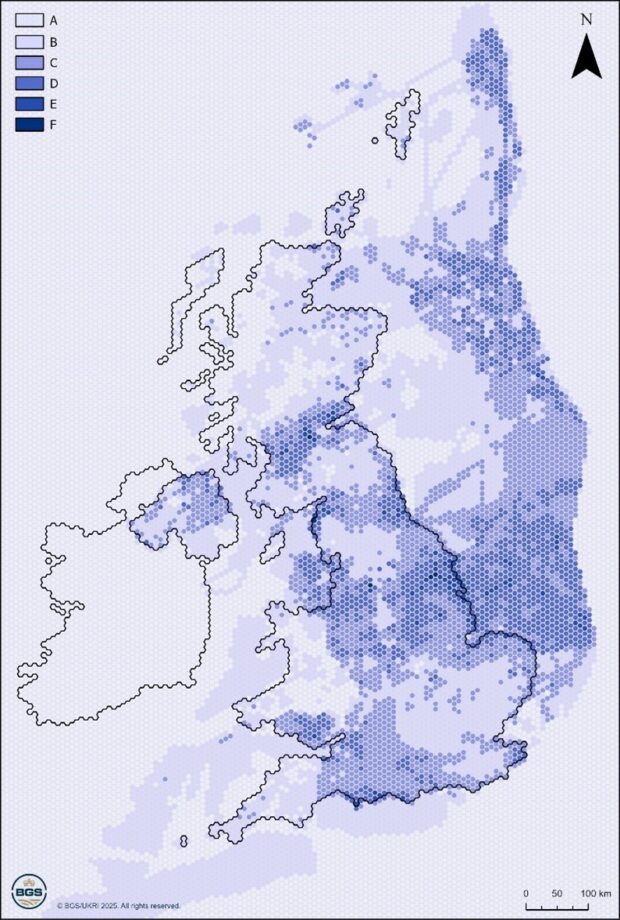
BGS previously mapped the potential of the subsurface to host these low-carbon technologies based on geological setting. They combined these maps with one another to see which parts of the UK could host multiple net zero technologies (see darker areas in the map below).
In England, this includes the east, north east, Cheshire Basin, and Wessex Basin – places close to where planned net zero industrial clusters are located.
“It’s no coincidence that areas with the greatest geological potential for the energy transition sit alongside major industrial clusters. Industry originally grew where the right rocks and resources were found,” said geologist Dr Jim White, project lead at BGS. “Today, those same sedimentary basins and salt formations that once powered industrial development can store carbon, hydrogen, and heat, allowing us to repurpose both the geology and the infrastructure to support net zero and clean growth.”
How could underground crowding affect the environment?
We hosted a workshop to hear from industry, government, and universities. From these conversations, it was clear that environmental issues might arise where infrastructure from different technologies accidentally connect. For example, boreholes are often drilled into the ground to transfer fluids to and from the subsurface. If they collide with other infrastructure, this can create holes that become pathways for pollution to reach groundwater.
“These environmental impacts might be small when considering a single technology but can add up when combined with effects from other technologies,” said Dr Sian Loveless, geoscientist and project lead at the Environment Agency. “However, using neighbouring space in the subsurface can open up opportunities for industries to work together and reduce their impact on the environment.”
Better planning can help industries to complement, rather than compete, with one another for space and resources. Doing so can help minimise disruption from construction and operations at the surface, while reducing the number of boreholes that need to be drilled into the ground.
And what about people?
It is also important to consider how the use of the subsurface by net zero technologies might affect society, since this will influence how and where these technologies can be used.
“Social scientific evidence is an integral part of our research,” said Dr Katie Dow, who led the Environment Agency’s exploration of social and behavioural science on this project. “Understanding what the public thinks, feels, values, and fears makes us better equipped to achieve a net zero transition that aligns with their priorities.”
We found that the public want to know that net zero technologies are safe and effective. Other factors that shape public opinion include past experiences with industrial installations, views on climate change, and trust in operators. One lesson from the literature and workshop was clear: it is always important to engage early and transparently.

Making space for a low-carbon future
A particular challenge we found was joining up the different timescales at play – technological, climate, environmental, and geological – that reflect changes happening today through to 10,000 years in the future. When would technologies be ready to break ground? How long would they be in operation? When could environmental and social affects be felt? Future work would benefit from “grounding” these issues within places to pin down the details.
By supporting a range of technologies that reduce greenhouse gas emissions, the subsurface is part of the nation’s solution to reaching net zero and combatting climate change. This work has helped us understand and anticipate how this might look in terms of timing, space, and combinations of different technologies. By considering a range of net zero options upfront, we can plan the subsurface in ways that work better for the climate, for nature, and for people.
Leave a comment