
In our previous blog, we looked back at the Buncefield incident, our role in the response, and how it shaped the way we regulate high-risk sites.
For this second piece, we want to share first-hand experiences from some of our colleagues who were directly involved. Their memories highlight the scale of the incident and how it continues to influence our work today.
Colin Chiverton, Area Environment Manager, Thames Area
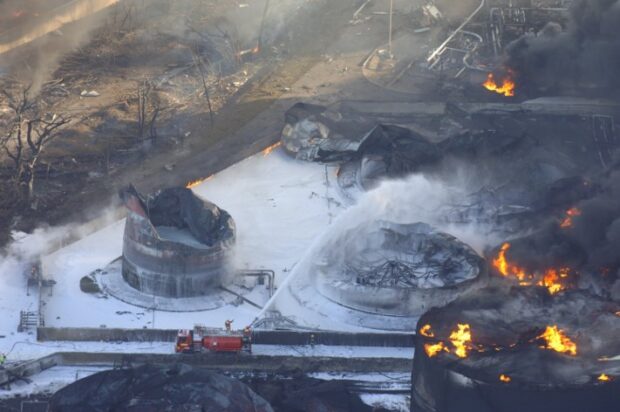
“On 5 December 2005, I was the first person from the Environment Agency to attend Gold Command at Hertfordshire Police Headquarters for the multi-agency response. I then led the Agency’s joint complex and major investigation, with the Health and Safety Executive, into the cause and environmental consequence of the incident. I continued to lead our investigation until, in July 2010, we attended St Albans Crown Court for the sentencing of the five guilty defendants.
The outcome of the investigation was a landmark fine for environmental pollution and consequences to the high-hazard industry. I was proud of the whole team response and result – but what a five years of our lives.”
Rob Argent, Operations Team
“Even after 20 years I have vivid memories of the incident and the emergency response. Every day on my way to the Hatfield EA offices I used to drive along a small lane called Three Cherry Tree Lane that runs right alongside the fuel terminal. I lived in Hemel Hempstead at the time of the major accident and by chance I was on incident standby duty. I attended some of the initial emergency services command meetings.
My father also worked for a company located only a few hundred metres from the fuel terminal. After Buncefield, his company was forced to relocate and my old shortcut was closed for many years. I now work in COMAH (Control of Major Accident Hazards) regulation in the South West, inspecting high-hazard sites similar to Buncefield and making sure operators apply the lessons learnt from this major accident.”
Michael Nicholas, Senior Advisor for COMAH and Climate Change Adaptation
“My memories of Buncefield stack up like a pile of postcards, a series of images of catastrophe but also hope. From the day of the incident, supporting the Environment Agency response as an officer at our Area Incident Room, through weeks and months of on-site investigation, the preparation of court files and the subsequent work to ensure lessons have been learned forever.
I am proud of my role in ensuring learning from Buncefield has led to significant improvements in industrial safety, protecting people and the environment from major accidents. Some specific memories remain etched in my mind:
• The menacing black cloud hanging above my garden, 45 miles away from Buncefield.
• The hundreds of fluorescent-clad emergency service personnel packed into the foyer of the Hemel Hempstead Holiday Inn, all working with a common aim – to bring the site under control while protecting people and the environment.
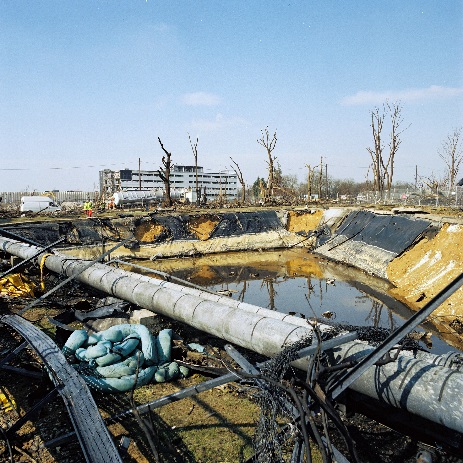
• The first day investigating on site: twisted metal, shattered glass, collapsed ceilings, and a black oily lake over what had once been a tree-lined country lane.
• Weeks later, returning to see the exhausted, pale faces of oil company staff – often forgotten as Buncefield victims.
• Months later, collecting a formal groundwater sample that looked like dark stout but smelled strongly of oil.Beyond those moments, I remember the determined faces of regulators and industry experts working together to revise countless codes, standards and good practice documents – all to ensure an incident like Buncefield should never happen again.”
A reflection on Buncefield
The memories shared by our colleagues show how deeply the Buncefield incident affected those involved. Their stories underline why the Environment Agency continues to work so closely with partners and industry to minimise the risk of another major industrial accident.
A message from our Chief Regulator Director, Jo Nettleton
“The Buncefield explosion 20 years ago was a pivotal moment for industrial safety and environmental protection. In its aftermath, we helped shape new fuel storage standards and worked closely with the industry and other regulators across England, Scotland and Wales to embed the lessons learned, which were published in 2011.
This progress demonstrates the power of collaborative regulation that is evidence and intelligence based to target the highest controls to the highest risks and apply it proportionately and consistently. Even 20 years later, remediation work at Buncefield is on-going. It stands as a reminder of what’s at stake and of what can be achieved when regulation drives continuous improvement and safeguards both people and the environment.
As we look to the years ahead, emerging risks from ageing infrastructure, climate change, and new technologies are presenting new challenges. We are meeting those challenges by strengthening our COMAH regulatory capacity to work even more closely with operators to enhance oversight, improve risk management, and continue to ensure robust safety controls are in place”.
If you would like to hear more updates and insights from our teams on topics like this, please follow our Chief Regulator LinkedIn account.
1 comment
Comment by Rick Smyth posted on
Was it a plane? Was it thunder? Was it a meteorite?
6.04am Sunday 11th December 2005. Leverstock Green, Hemel Hempstead, Herts..
I was woken by a crescendo of noise like a 10 ton juggernaut rumbling down our road towards us. Taking the opportunity to visit the bathroom (always welcome at our age) I put a leg out of bed when ‘’Flipping Heck what the flipping heck was that’’ I exclaimed to myself at the sound of the loudest explosion I’d ever heard accompanied by a rush of wind. All sorts of potential explanations fill your mind! Was it a plane?, was it thunder?, was it a meteorite? Where’s Sheila?
A peep out of the window into the darkness confirmed that all was not well as it appeared the house in the next road (50m) had a 20m column of fire and smoke coming from the roof.
I rushed (OK, dawdled) to Sheila’s room (ironically my wife had long since gone into the spare room to escape the noise of my snoring) to see if she had heard it and to report my sighting. (she’s not deaf I just was not thinking). She had and was on her way out of the front door in her dressing gown and slippers to join the neighbours wandering around outside in a daze like a scene from an American Sci-fi movie.
She came back with the news that it was not the house 50m away with a 20m fire column but probably the oil store depot 1.5 km away with a 100m column of fire lighting up the early morning darkness.
Flicking between Sky News and BBC 24, I award Sky News points for speed but no points for accuracy. At 6.15am Sky’s breaking news was that a plane had crashed in St Albans (10km away), because their man on the ground (a veteran Sky war correspondent who happens to live in St Albans) heard the bang, looked out of his window and guessed wrong. It was great hearing him eating humble pie as he travelled away from St Albans towards Hemel following the flames and smoke. Sky’s rolling news changed to ‘It’s not a plane crash, sorry’
By 6.30am four more lesser explosions confirmed the view that indeed it was the Buncefield Fuel Store Depot that was on fire. This vast depot (one of about six in the UK of this large size) stores various types of fuel in over 20 containers each holding 3million gallons of fuel, including aviation fuel to be piped to Heathrow and Gatwick airports.
By 9am all news channels were on the case with stories of 2000 people evacuated, buildings demolished and a major incident declared. We were receiving phone calls from concerned family and friends. Time to dress and read the paper. So back to the bedroom but noticing a chill in the air, I pulled back the curtains to find the windows had been blown out on their hinges. A look around the house found a glass patio door smashed (luckily only the inner of the double glazing), the garage door blown off its runners and a very clingy Pebbles the cat. Also no newspaper had been delivered. This was getting serious. So off to the paper shop only to find shattered shop fronts, swarms of police in and around the village hall and various media groups and locals setting up at any available vantage point. A phone call to my daughter on the other side of town resolved the Sunday Paper crisis.
9.30am and throughout the day, TV reported that the motorways M1 and M10 were closed. People from as far away as the East and South Coasts (100km) reported to have heard the blast, even the decrepit Roy Bertauche (Mr EBOG) was woken 15miles away. Helicopters were monitoring the smoke column as it rose vertically to 1000km then it followed the M25 and the M4 westwards. Fears of toxic smoke from the experts were being examined. We were fortunate that there was no low level wind. for the next three days, so it rose above us and away. The 2000 evacuees were being cared for in local halls. Hertfordshire Police were holding regular press briefings gradually ruling out sabotage or terrorism and thankfully reporting no fatalities. (much to the dismay of the media hounds or am I being cynical?)
Monday, Tuesday, Wednesday.
The fires were gradually being doused by the 100 or so fireman from Hertfordshire and surrounding counties. The large globules of foam covering our cars and windows and the smell of fuel were signs that they were still in progress.
The authorities had organised builders and surveyors from the home counties to shore up homes to allow families back. The Industrial Estate was fully opened again by January 3rd but looking like Bierut with 20 of the 80 buildings completely destroyed. If this had happened in the working week the fatalities would surely have risen from the amazing zero to several hundred.
By Thursday all fires were extinguished and the smoke much reduced.
The nearest commercial building to the largest storage container (apart from the Depot’s buildings) and worst hit was owned by Northgate Business Solutions. They had two people working inside who although injured, managed to escape and flag a car down to take them to Hospital.
Northgate were reported in the Daily Telegraph as being a model company in as much that they were up and running by noon on the Sunday from another site by having a recovery plan involving off-site data back-ups.
Their building was originally built in 1984 by a rapidly expanding Microdata Computers Ltd, a subsidiary of McDonnell Douglas Corporation, the company I worked for and the building I worked in for 5 years. Although 9/11 hadn’t happened, we still had terrorism fears e.g. IRA, but at £400,000 per acre the 15acre site appeared too cheap to pass. It seemed a good idea at the time.
According to Hertfordshire’s Fire Chief ‘this largest incident of its kind in peacetime Europe’ was not caused by terrorism but probably by leaking fuel sparked by a tanker vehicle starting up.
Indeed the few tanker drivers present in the depot at the time had the luckiest escape as they were running from the scene realising the smell of leaking fuel may start an explosion. Their fears were emphasized as shards of metal from the containers and buildings whistled past their ears as they were knocked to ground by the blast.
In the aftermath many inquiries by Health & Safety, the oil companies, the Fire & Police etc. are emerging. The total cost of the disaster is estimated at £200m.
Hemel people are split (54% against) as to whether they would want the Depot (which was built in 1968 before the Industrial site) rebuilt.
Pictures and local stories can be viewed on website http://www.hemeltoday.co.uk.