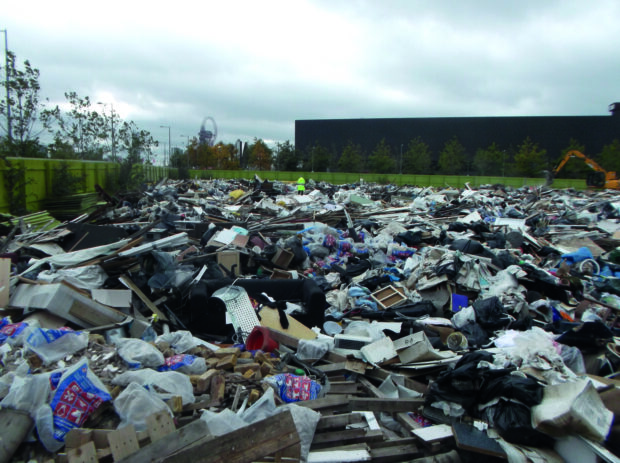
Waste crime is serious crime - blighting local communities, harming the environment and undermining legitimate businesses.
In May, we have published a national watchlist of high priority waste sites in England, as part of the Environment Agency’s enhanced response to tackle the issue.
The watchlist gives communities greater visibility of where we are taking action and forms a central part of our 10 Point Plan to tackle waste crime, a comprehensive strategy that places transparency and community engagement at its core, while encouraging the public to report any activity they see and are concerned about.
On 1 October, we published new public information releases [insert link] for a selected number of high priority waste sites. These documents provide information on the current status of a site, such as confirming whether its been closed or being closely monitored.
They also outline the actions taken by our teams, such as launching a criminal investigation, and indicate where we are working with partners to resolve issues.
Waste crime is a growing and increasingly sophisticated threat, and tackling it demands a genuine partnership approach – government, regulators, local authorities and the public working together to spot criminal activity early and stamp it out.
We are sending a clear message: we will not tolerate illegal waste activity and will hunt down those behind it.
This blog answers the most frequently asked questions about our watchlist.
Where exactly are these sites?
We have published information on sites across England.
The watchlist forms part of our enhanced intelligence gathering to enable residents to see where we are acting - a key commitment of the Environment Agency’s 10 Point Plan to tackle waste crime.
We cannot prejudice ongoing enquiries and any associated enforcement action and due to this will not be providing further breakdown of these sites. Whether any activity is illegal is ultimately a matter for the Courts to decide.
However, we recognise the need to support communities in accessing information which might affect them. This is why we have started to publish new public information releases on selected sites, with more to follow over time.
Are these all the sites that we are aware of?
There are currently around 700 known waste sites across England. This list covers the sites we consider to be high priority sites.
What is high priority?
A site is considered high priority because it is causing concerns within local communities, and the list enables residents to see where we are working now.
Accurate local information to effectively tackle waste crime is critical in protecting people and the environment from any potential risks.
If you have any information about any of the sites included in our watchlist, or suspect illegal waste activity anywhere, please call our 24-hour incident hotline on 0800 807060. You can also report information to call crime stoppers via their website.
What is the EA doing at these sites?
All reports of illegal waste sites are taken extremely seriously.
Sites are subject to investigations by our regulatory teams where they work through a range of options to deal with them.
For sites presenting lower levels of risk, we work to bring them into compliance through regulatory action and engagement.
Sites that present serious risks will receive our most intensive attention, which can include criminal investigations.
More information on action already taken and future action will be included in our public information releases as they are published.
Will the watchlist be regularly updated?
We intend to update it every month as we recognise the need to support communities in accessing information which might affect them.
We will publish more public information releases on individual sites as they become available.
Why have sites been removed from the list?
Some sites are removed from the list when our assessments show they now present a lower level of risk to nearby communities.
This picture will never be static. It will continue to evolve as we review activities, receive updated reports, and resolve issues.
Even when a site is removed, our enforcement teams will continue to monitor it closely and take action whenever necessary to stop illegal waste activity.
Those responsible will still be pursued and we will seek to recover the costs of the clean-up where possible.
Will we be clearing all these sites?
We are not funded to clear waste sites.
We also do not want to create a perverse incentive for waste criminals to dump waste.
However, in line with the polluter pays principle, we will always seek to ensure that those responsible for dumping waste in our towns and cities pay for the cost of cleaning it up.
Why are you clearing up some waste sites?
The sites announced by the government for clean-up were chosen due to a specific criteria, which includes posing a serious environmental risk and impact on the local community. This was a decision made by the government.
What are we doing to tackle waste crime across England?
We do not underestimate the real impacts on local communities across England affected by waste crime sites.
In March, we launched our 10 Point Plan to tackle waste crime, with action to establish a new Intelligence Unit, move faster to shut down illegal waste sites and make greater use of enforcement tools.
As part of this, we organised Operation Unite which was an 18-week nationwide enforcement operation targeting permitted waste sites suspected of being involved in criminal activity. This saw 42 waste sites inspected, resulting in 17 permits suspended or revoked and over 30 criminal investigations triggered.
This forms part of a focused, sustained programme to strengthen prevention, improve detection and deliver more consistent enforcement.
However, this cannot be addressed by us alone – with the public and other law enforcement partners, we can make lasting progress against waste crime.
The Government is cracking down on waste criminals with it new Waste Crime Action Plan setting out a zero-tolerance approach to put an end to the damage they cause.
In August, the Prime Minister also unveiled further measures to tackle waste crime. This included better use of drones, a bigger role for the police and the National Crime Agency and more of our officers on the frontline.
This is sending a clear message: dump illegally and you will face the full consequences.
What can the public do if a site in my area is not on the list – or they have more information about one of the sites?
Accurate local information to effectively tackle waste crime is critical in protecting people and the environment from any potential risks.
If the public has any information about any of the sites included in our watchlist, or suspect illegal waste activity anywhere, they can call our 24-hour incident hotline on 0800 807060.
They can also report information anonymously to Crimestoppers via their website.
2 comments
Comment by Asher Zion posted on
This is a really important step toward greater accountability in tackling waste crime. Giving communities clearer visibility of high-risk sites helps build trust and encourages public involvement in reporting issues early. Transparency like this can make environmental enforcement more proactive rather than reactive, which is exactly what’s needed.
Comment by Angel Pros posted on
A really important step toward transparency—giving communities clearer visibility of waste sites helps build trust and makes it easier for people to report concerns early. It’s encouraging to see stronger accountability being paired with public engagement, especially on an issue that directly affects local environments and health.