Elizabeth Maerz, Environment Officer for Cumbria
Every day, our officers investigate pollution reports across the country's rivers and lakes. Surprisingly often, the cause is something quite ordinary: a household drainage system connected the wrong way round.
Windermere, England's largest lake, has become one of the most visible examples of this hidden problem. Here's what misconnections are, why they matter, and how you can help us find and fix them.

How do pipe misconnections happen?
Most modern homes have two separate drainage systems. One carries wastewater from toilets, sinks and washing machines to a treatment works. The other carries rainwater from roofs and driveways straight to rivers and lakes.
A misconnection happens when these get mixed up, usually during home improvements or renovations. When wastewater ends up in the surface water system, sewage, detergents and food waste flow directly into rivers and lakes, bypassing treatment entirely.
You can sometimes spot one just by looking at the pipework outside a newer property: if a pipe from a bathroom or kitchen is connected to a rainwater downpipe, that's a red flag.
These faults are surprisingly common and hard to trace. In 2019, Defra estimated that between 150,000 and 500,000 UK households may have a misconnection, and new ones keep appearing whenever drainage is altered during building work.
Mill Beck: a case in point
Mill Beck, which feeds into Windermere, shows just how tricky these faults can be to pin down. The beck has long had elevated phosphorus and bacteria levels, especially in dry summer months.
We first investigated in 2018 and identified where pollution was entering the watercourse. United Utilities repaired nearby sewers, but monitoring by the Environment Agency, Windermere Town Council and the Big Windermere Survey showed the problem hadn't gone away.
So, in summer 2025, we went back for more extensive monitoring, and found pollution was still entering at the same spot. That led to a joint investigation with United Utilities and Westmorland and Furness Council, using CCTV surveys and dye testing across the local sewer network. The evidence so far points to misconnections as a likely contributor.
Next, we'll be working with residents to carry out further dye testing at properties in the area, to confirm whether domestic drainage is behind the pollution.
How do I report a potential misconnection?
Many of our investigations start with a member of the public noticing something odd while out walking or by the water. Around Windermere especially, local residents and visitors have been vital in flagging unusual smells, discoloured water and visible discharges.
Watch out for:
- water flowing from a pipe into a river or lake during dry weather
- dead fish or distressed wildlife
- unpleasant odours or oily sheens
- discoloured water
- excessive algal growth
- sewage litter or sewage fungus
Not every discharge is a problem (garden watering run-off is harmless), but a persistent flow in dry weather is a warning sign.
If you spot any of these, report it to the Environment Agency online or call our free 24-hour hotline: 0800 80 70 60. Your report could be the missing piece we need to track down a pollution source, whether that's at Windermere or a stream near you.
How does the EA resolve misconnection problems?
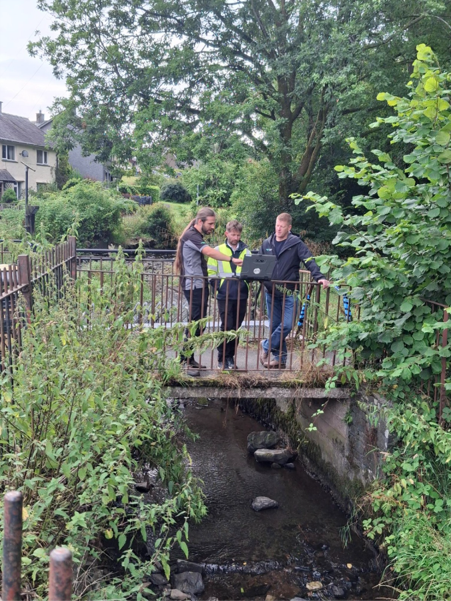
Once we've got a report, we investigate; water sampling, checking drainage systems, and working with water companies on dye testing and CCTV surveys to trace exactly where things have gone wrong. You might spot us doing this at Mill Beck in the coming weeks.
Fixing a misconnection is legally the property owner's responsibility, and water companies provide guidance to help. Most people sort it out voluntarily; where they don't, local authorities can enforce action under the Building Act 1984.
The good news: misconnections can be fixed, and each one we correct helps improve the health of our rivers and lakes.
Working together for cleaner rivers
Misconnections are hidden underground, but their impact is felt in every river, stream and lake we care about, from Windermere to the smallest local brook. Understand the problem, report what you see, and together we can help resolve it.
Understand. Report. Resolve.
Find out more
Leave a comment