
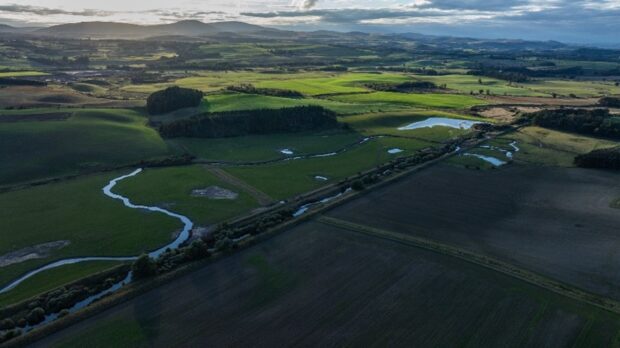
Tucked away in the beautiful Breamish Valley, south of Wooler in Northumberland, one of the UK's most ambitious river restoration projects has recently reached completion - and the results are already remarkable.
The River Breamish at Harehope Estate is flowing freely once again, finding its own course through a landscape it was separated from centuries ago. But this project is about much more than one river. It's a blueprint for how we restore our waterways for generations to come.
Like so many rivers across the UK, the Breamish was disconnected from its past. It was historically straightened and modified for agricultural purposes with around a mile of natural river channel lost.
Over-management through dredging, bank protection and flood embankments kept it pinned in place, disconnected from its floodplain and the rich mosaic of habitats that depend on that relationship.
The result was a river officially classed as being in 'unfavourable condition', with declining freshwater species, reduced biodiversity and increased flood risk downstream.
What makes this project stand out is the way it has blended the historical with the cutting-edge to find the right answer.
The team turned to ancient maps held in the archives at Alnwick Castle, some dating back to the 1600s, to trace the river's original course and meanders. That historical detective work was then combined with modern Light Detection and Ranging (LiDAR) technology, which created detailed 3D models of the terrain to pinpoint exactly where the river once flowed.
From there, the restoration work included excavating and diverting the river into its historic channels, installing silt traps, shallow ponds, wetlands and woody dams to deflect water into the new channels.
Crucially, the river has been given room to find its own 'final design' - and it's already doing so, spilling onto its floodplain, forming wetlands, and adapting and changing naturally with every rainfall event.
Wildlife has responded quickly. Heron, kingfishers and damselflies have already been spotted using the new habitats; water crowfoot, a rare plant central to the Till catchment's protected status, is establishing in the new meanders, and salmon and sea trout are moving freely through the site to their upstream spawning grounds.

But perhaps the most important lesson from the Breamish project, which was delivered through the LIFE WADER nature-recovery project, is that restoration at this scale is only possible with landowners on board.
Working with Harehope Estate, the partnership - Tweed Forum, Environment Agency and Natural England – supported the transition away from an intensively managed river to one with space to move and breathe.
The Countryside Stewardship scheme has played a vital role in recognising the long-term land management changes needed to make that transition sustainable.
The government scheme provides financial help for farmers, foresters, and land managers in England to enhance the natural environment.
The results are already inspiring neighbouring landowners to explore what restoration might look like on their own land - a legacy effect that could ripple far beyond this single site.
The pioneering Breamish project is a key element of the River Till Restoration Strategy, which has now been working to improve the Till catchment for more than a decade.
That long-term commitment has transformed a landscape of exceptional conservation importance, home to otter, Atlantic salmon and all three native lamprey species, by tackling the cumulative impacts of centuries of modification, one stretch at a time.
The breadth of that improvement is visible across the whole catchment, from improved water quality and fish passage to stronger flood resilience and richer habitats throughout.
The Till strategy shows what a decade of strategic thinking, partnership working and genuine community engagement can deliver.
It's not just the story of one river finding its way home, it's a model for how we give nature the room it needs to recover.
1 comment
Comment by Ian Gregory posted on
Nice job