
What does Calverton Fish Farm do?
Funded entirely by anglers’ fishing licence income, Calverton Fish Farm just outside Nottingham is a key part of the Environment Agency’s goal to maintain, develop and improve freshwater fisheries across the country.
We work with the Environment Agency’s 14 area fisheries teams to help determine what fish are needed and where. By closely working with angling clubs and fishery owners our area teams draw up a list of fish that are required each year. This can be for restocking after pollution incidents, on the back of habitat enhancement projects or to help create new fisheries. As a rule, we only stock where help is needed. We don’t stock hatchery fish where there are already healthy natural stocks present.
How Calverton rears fish for life in the wild
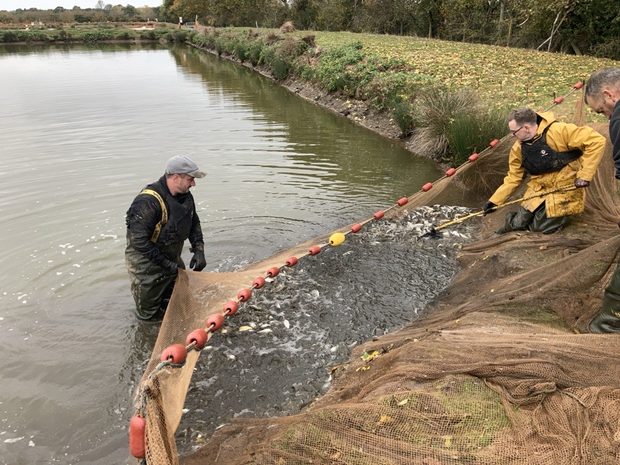
At Calverton, each season is busy, but autumn is exceptional, as this is the time when our fish are harvested from the large ‘growing on’ ponds on site, separated into their various species, sampled, counted and health-checked before they are ready for dispatch to a variety of rivers and lakes throughout England.
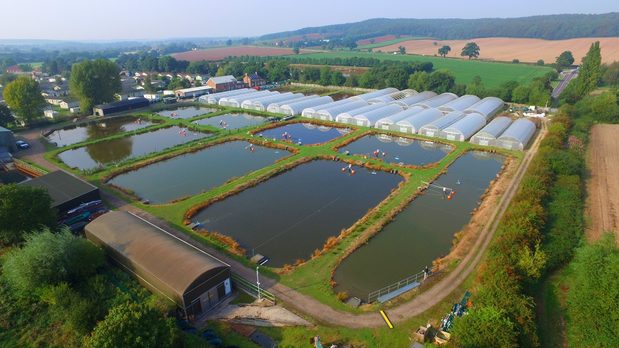
It takes approximately 18 months to rear our fish to a size where we can stock them out into rivers and lakes. All of the Calverton stocks are reared in semi-natural ponds that have lots of natural food, habitat, and plenty of flowing water. This ensures that our fish are fit enough to live in the rivers and that they can face the challenges that come from life in the wild.
Restocking the River Derwent in Derbyshire
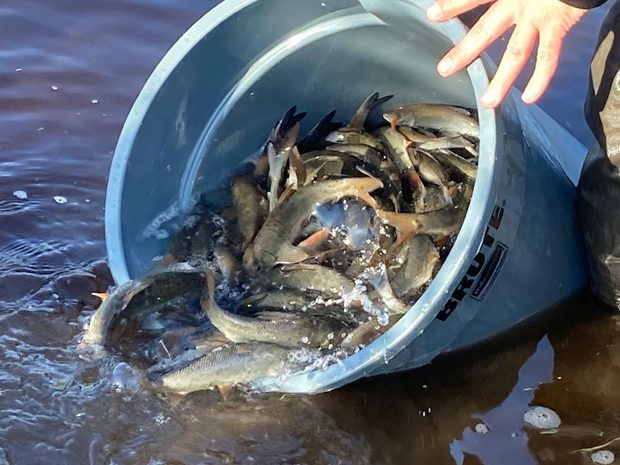
One of these stockings took place on a cold and misty early November morning when on the banks of the River Derwent. We came to stock 1150 Chub, Dace, Roach and Barbel into the river, much to the excitement of the members of the local angling club in attendance.
We took the lids off the specially fitted tanks on the back of the pickup to reveal thousands of small shapes darting around in the bubbles of oxygenated water. A quick dip of the net and there was an explosion of silver and brown as hundreds of Chub, Roach, Barbel and Dace got carried down to the river and released into the moving current.
It’s taken 18 months of hard work and painstaking processes to get the fish to this point; including a lot of work between the angling club and the local fisheries team. The best bit is seeing them swim off into their new home. It is so rewarding and makes all those early mornings, late nights and the hours of care and attention worthwhile.
How fishing licence income funds fish restocking
A similar stocking process will happen hundreds of times over the next couple of months at multiple sites as the team at the Fish Farm stock out over half a million coarse fish into England’s rivers and stillwaters.
It’s all made possible by anglers who buy their licences up and down the country. Without your investment, we could not carry out this vital work and so much more.
Find out more about buying a fishing licence and read more about our where your licence income goes in our annual report.
If you see illegal fishing activities on any inland water report in England, contact the Environment Agency’s Incident Hotline immediately on 0800 80 70 60 (available 24/7) or online via Report an Environmental Problem.
Leave a comment