
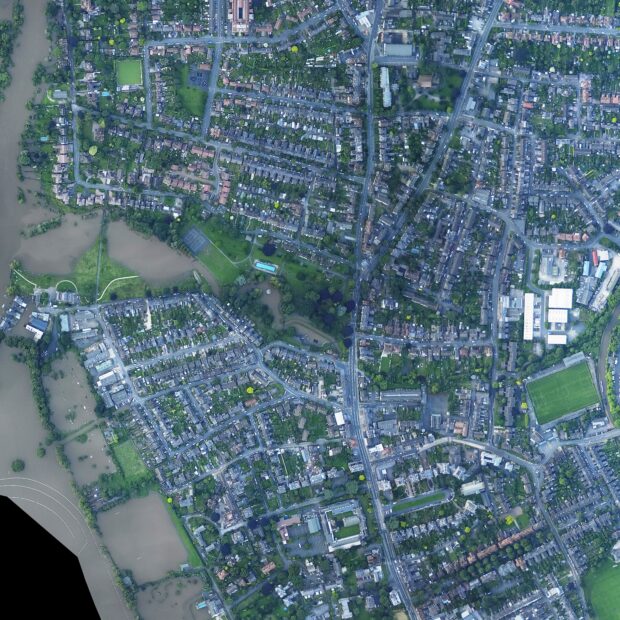
Flooding affects many communities across England. As climate change increases the frequency and severity of extreme weather events, new Environment Agency research shows that ensuring our approach to flood risk management is both effective and equitable has become more important than ever.
Flood risk is not evenly distributed
For over two decades, Environment Agency research has shown a relationship between flood risk and deprivation. Our latest analysis confirms that these inequalities persist today.
The National Flood Risk Assessment indicates that around 6.3 million properties in England are in areas at risk of flooding from rivers, the sea, surface water, or a combination of these sources. Of these, approximately 4.6 million properties are in areas at risk from surface water flooding.
By combining property-level flood risk data with population estimates from the Office for National Statistics, we estimate that around 11.3 million people in England live in areas at risk of flooding.
Our analysis shows that more than 2.5 million people who are vulnerable to flooding from rivers, the sea or surface water also live in the 20% most deprived neighbourhoods in England.
Approximately 9.3 million people in England are exposed to the growing risk of surface water flooding, which occurs when heavy rainfall overwhelms drains and drainage systems, causing water to accumulate on the ground leading to flash flooding. Of these, 2.1 million live in the most deprived towns and cities in England, meaning that nearly one in four people exposed to surface water flooding are in the country's most disadvantaged urban communities.
Coastal communities experience some of the most pronounced inequalities. Around one-third of people living in coastal areas at risk of flooding also live in the most deprived areas of England.
Why this matters and how we are tackling inequality
Our analyses highlight that flood risk is not a marginal issue. It effects a substantial proportion of the population affecting communities in every part of the country. The uneven distribution of risk matters because flooding does not affect all communities in the same way.
Communities experiencing deprivation often:
- have fewer resources to prepare for flooding
- face greater disruption when flooding occurs
- take longer to recover afterwards
The Environment Agency has recognised this challenge in its updated flood and coastal erosion risk management (FCERM) funding policy.
An important feature of the policy is a stronger focus on fairness and targeting investment where it is most needed.
The policy sets out clear commitments:
- At least 20% of FCERM investment will go to the most deprived communities
- At least 40% will go to the two most deprived groups combined
We are also working with the British Red Cross to find ways of supporting those at flood risk. This includes initiatives such as the Building Resilience Together programme; which is creating local centres or ‘hubs’ with the goal of building local preparedness and resilience. We also work with Communities Prepared who provide training and information for local volunteers who want to support their communities during emergencies.
In addition, we are a part of the Action Group on Communications and Community Engagement for the Floods Resilience Taskforce, which brings together experts and decision makers from across UK government, non-government and industry organisations at local and national level. It includes people involved in all stages of flooding resilience, including preparedness, response and recovery and has a particular focus on vulnerable communities.
We are also testing to see if different ways of working with people to make their homes fit for the future are effective. The Resilient Roch project in Rochdale for example is providing household surveys to assess flood risk, heating and home insulation. This approach combines flood management, energy efficiency and the chance to talk about those issues with those more vulnerable to future flooding and climate change.
2 comments
Comment by Julian P Jones posted on
The late Dr Geoff Mance (EA Water Resources) advised in 2000 (see New Scientist) that at that time changes in arable farming practices had reduced aquifer recharge (conversely increasing flood run off) by 20%. What is your current estimate of this - for both pastures & arable as they are both have severely compromised porosity caused by chemicals usage since 2000? Also of course leading to intensive storms ...
Comment by Robert Williams posted on
CLEARING THE RIVERS WOULD SOLVE MOST PROBLEMS.THE EA SHOULD BUY MORE LAND TO USE AS WATER STORAGE AND NOT RELY ON FARMERS WHO CANNOT USE THEIR LAND BECAUSE OF CROP DAMAGE DUE TO THE THE LACK OF ACTION ON THE REAL PROBLEM