Protecting fish health and supporting sustainable fisheries is a key priority for the Environment Agency. We work closely with partners and fishery managers to reduce the risk and impact of fish health incidents, including Koi herpesvirus (KHV), which affects carp and presents a risk to recreational fisheries from potential significant fish mortalities.
From 2026, the Fish Health Inspectorate (FHI) are changing how they may respond to and control KHV in fisheries. This is part of a targeted operational change towards a more proportionate risk-based approach for managing KHV disease in England and Wales. The FHI remains responsible for statutory surveillance and control of listed aquatic animal diseases, including KHV. We will continue to support the FHI in response to listed and emerging diseases as well as our own remit to protect the health and resilience of fisheries.
The Environment Agency’s role
We will continue to play a key role in responding to fish health incidents and reducing the risk of spread between recreational fisheries.
Where fish mortalities occur in fisheries we will:
- Continue to investigate significant mortality events in fisheries under our remit to maintain, improve and develop fisheries.
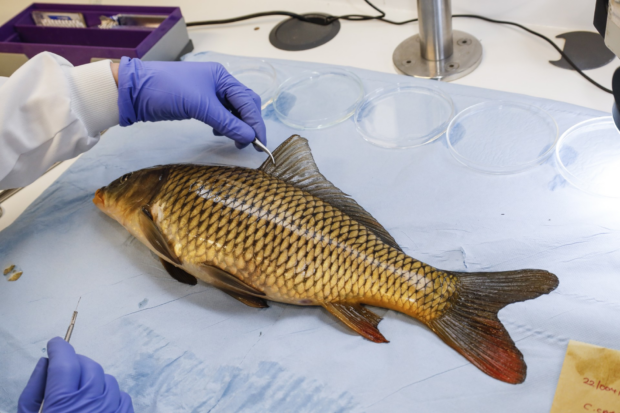
- Conduct fish health investigations to determine the cause of mortality and inform appropriate management and biosecurity measures. Report any suspicion of listed disease to the FHI throughout our investigations
- Support fisheries by providing advice, guidance and management measures that aim to reduce stress to fish experiencing a disease outbreak, including for KHV where stress is a significant factor that triggers clinical KHV disease outbreaks, and where reducing stress remains the best way to mitigate the risk and impact of the disease.
Where KHV is confirmed, we may:
- Not issue authorisations to use equipment at fisheries to aid recovery following a mortality, to support good biosecurity practices and reduce likelihood of disease transfer to other fisheries until the risk has reduced. These measures are separate from and do not replace the Fish Health Inspectorate’s statutory responsibilities for listed disease surveillance and control.
- Monitor fish health and mortalities at the fishery
These actions are intended to support good fisheries management and biosecurity practice, particularly during periods when the risk of KHV disease expression and onward spread may be higher. We will work closely with the fishery owners to provide them with advice and guidance to support them during an outbreak.
We will continue to work closely with the Fish Health Inspectorate to protect the health of our fisheries nationally.
When restrictions are lifted
Applications to use equipment for the purpose of moving fish may be authorised once temperatures have dropped below those associated with outbreaks of KHV disease. This will usually be when:
- Fish deaths have stopped, and
- Water temperatures fall below those required for disease expression.
We will work with fishery managers throughout this process and provide advice to support recovery.
What you need to do
Fishery owners, managers, and anglers all have an important role to play in protecting fish health.
- Report fish deaths or distress: Contact the Environment Agency incident hotline on 0800 80 70 60.
- Report suspicion of listed disease: If you suspect a listed disease such as KHV, you must notify the Fish Health Inspectorate.:
- Email: fhi@cefas.gov.uk
- Telephone: 01305 206700
- For urgent enquiries, including reporting disease suspicion, a 24/7 on-call service is available via this number.
Follow biosecurity best practice: Good biosecurity practices and fish movement controls remain essential to preventing the spread of disease.
Supporting healthy fisheries
These changes aim to strike the right balance between protecting fish health and reducing unnecessary burdens on fisheries. We will continue to respond promptly and effectively to disease risks, while supporting fishery operators to manage their waters.
We will continue to review our approach and work with partners and stakeholders to ensure our response to fish disease remains effective, practical and proportionate.
1 comment
Comment by Hayley Carlin posted on
Wrong contact details for the FHI - please refer t their GOV.UK page