
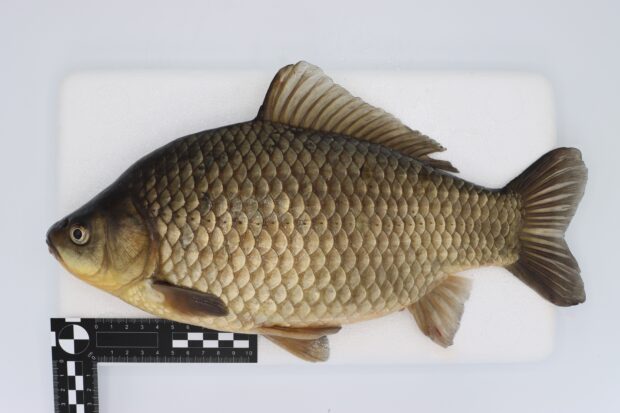
This week marks Invasive Non-Native Species (INNS) Week, a chance to shine a light on the quiet, often unseen work protecting our waters.
Not every threat to our fisheries is obvious. Sometimes it begins with a report of unexplained fish deaths, fish behaving abnormally, or a fish that doesn’t look like a native species. It might be an angler sending in a photo of something unusual. And sometimes there are no visible signs at all, just traces left behind in the water.
This is where the Environment Agency’s National Fisheries Laboratory comes in.
Based in Brampton, Cambridgeshire, the lab is a key part of the frontline defence for protecting England’s freshwater fisheries. The work is varied, and no two days look the same. One moment the team is investigating a fish mortality, the next identifying a parasite or a fish suspected to be a non-native species. It is detailed, highly specialised work that underpins how fisheries are protected across the country.
Why INNS Week matters
Invasive non-native species can change a fishery quickly, and sometimes permanently.
Some species outcompete native fish like roach and perch. Others introduce diseases that our fish have never encountered before. In some cases, non-native species carry pathogens that can spread across whole catchments if fish movements are not carefully managed.
Even a single introduction can be enough to cause long-term, irreversible damage.
Once established, non-native species and diseases are extremely difficult to remove, and sometimes impossible. This is why prevention is so important, and why early detection plays such a critical role.
What happens behind the scenes
The National Fisheries Laboratory is the Environment Agency’s specialist centre for fish health, disease and non-native fish species. Funded by fishing licence income, it provides a direct and practical benefit to anglers and fisheries across England.
The team is ready to respond when something goes wrong, investigating fish deaths, diagnosing disease and helping fisheries recover. But just as importantly, much of its work happens behind the scenes to reduce risks before they develop.
This includes carrying out health checks before fish are stocked or moved, identifying non-native species, and providing expert advice to fisheries managers. It is also where regulation becomes practical action, supporting decisions that prevent fish being moved from waters known to carry serious pathogens and helping to reduce the risk of those diseases spreading further.
Spotting risks earlier
Some of the most important work happens before anyone is aware there is a problem.
The laboratory uses a range of scientific techniques to better understand what is happening beneath the surface. This includes environmental DNA analysis, which can detect species from tiny traces left behind in the water. A single sample can reveal which fish are present, even when they cannot be seen.
This type of work is helping to build a clearer picture of fish populations and the pressures they face, supporting projects that improve our understanding of fisheries across England.
Alongside this, the team carries out detailed investigations into fish health, as well as ageing and growth analysis of our fish populations. These insights give fisheries the evidence they need to make informed decisions, helping to make their waters more resilient and safeguard them in the future.
The work anglers make possible
All of this work is made possible by fishing licence income.
It means fishery owners can report an issue and receive expert support, and that anglers who spot something unusual can get answers. It also means emerging threats, from new diseases to invasive species, can be identified and managed early before they cause wider harm.
Often, the outcome is reassurance. What may initially look concerning can turn out to be a natural condition or a common parasite. But when something more serious is identified, early action can make a significant difference in limiting the impact.
If something doesn’t look right
Early reporting plays an important role in protecting fisheries.
If you see dead or distressed fish, or spot an unusual species, report it:
- Incident hotline (24/7): 0800 80 70 60
- Fish health: fish.health@environment-agency.gov.uk
- Non-native species: non-natives@environment-agency.gov.uk
3 comments
Comment by Dave walker posted on
Great work on keeping fish heathy
Comment by R. Speirs posted on
Historically speaking, the numerous perch now found in Loch Brora, Sutherland, are an invasive species and likely to do harm to the indigenous salmonid population by preying on spawn and fry and by competing for food. Given the sudden rise in numbers, they are unlikely to have got there without human intervention.
Comment by Suzy Makai posted on
Hi there,
Im emailing you about some fish in part of a canal that is drying up - nearly completely now.
There are a family of Pike there and they are really struggling as the water is literally disappearing around them.
I have already witnessed an eel dragging itself out of the mud and collapsing and dying in the heat along with other fish trying to bury themselves in the mud that’s left. I have already contacted the Natural resources but have not had an answer or a reply and nothing seems to be getting any better. I know its only a few fish but the wildlife around will suffer to.
Can these fish be caught and taken to a better place nearby - further down the canal ?
The few other fish left in this part of the canal share the same fate shortly if someone does not intervene.
The fish are staying near the surface and the temperature of the water must be getting warmer by the day.
They are at a section of the Monmouthshire Canal behind Tiles Ahead which is located on TyCoch Way,Ty Coch Industrial Estate, Cwmbran Wales - they dont have long left please can someone save them and put them further down in the canal they are a few years old and quite big.
This unserviced area is almost dryed up now – I think they have literally days left if it carrys on.
I hope that someone can move them – not eat them, although that might be a kinder a fate !
PLEASE CAN SOMEONE TRY AND GET THEM OUT !!!!!