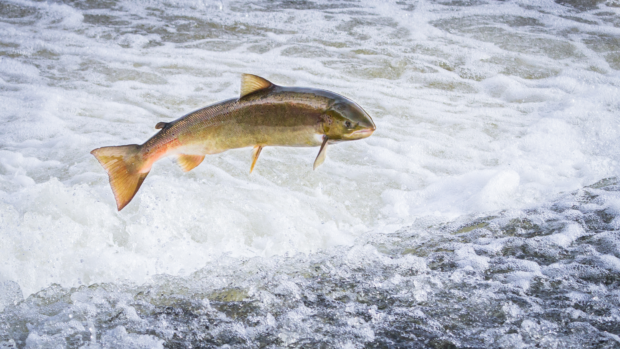
Atlantic salmon are a remarkable and iconic species. Hatching in rivers across Northern Europe, they migrate thousands of miles across the North Atlantic to feed and grow before returning to those same rivers to spawn.
Every year, the Centre for Environment, Fisheries and Aquaculture Science, the Environment Agency and Natural Resources Wales report on the state of our salmon stock levels, to help determine actions needed to protect this species. This annual assessment provides key insights into the health of salmon populations in England's principal salmon rivers, giving an important evidence base for understanding population trends, identifying rivers most at risk and helping target recovery activity where it can have the greatest impact.
The latest assessment, based on data from 2025 shows that Atlantic salmon stocks remain at critically low levels, with 40 of England's 42 principal salmon rivers projected to be classified as either "at risk" or "probably at risk" in 2030. This means 95% of our salmon rivers are at risk of having a salmon population below the level required for a long term sustainable population. This is not an isolated trend. Most salmon stocks across other UK jurisdictions and the wider North Atlantic are facing similar patterns.
Why are salmon declining?
There is no single reason for the decline in salmon populations. This problem is not unique to England and is observable across the North Atlantic. Much of the cause lies at sea and beyond the control of any single country.
Salmon face multiple pressures throughout their lives in rivers and in the sea, with freshwater habitats affected by pollution, migration barriers on rivers and water scarcity and marine habitats impacted by factors such as aquaculture and bycatch. Climate change is intensifying these impacts.
The decline seen today is the result of many of these pressures interacting over time, rather than any single cause.
Why are salmon important?
Atlantic salmon are one of England's most iconic fish species and an important indicator of environmental health.
Because they depend on healthy rivers, estuaries and seas throughout their lives, the health of salmon populations can tell us a great deal about the condition of the wider environment.
Efforts to improve conditions for salmon can also benefit many other species and help create healthier rivers for people and wildlife.
Is this just happening in England?
No. Salmon populations are facing challenges across much of the North Atlantic. Similar declines are being reported in other parts of the UK and internationally. This highlights the scale and complexity of the challenge facing the species.
What is being done to help salmon recover?
Action to improve conditions for salmon recovery includes improving river flows, restoring habitats, improving fish passage, tackling pollution, supporting catchment partnerships, fisheries enforcement activity and improving scientific understanding of the pressures affecting salmon populations.
Recovery will require sustained action from government, regulators, water companies, environmental organisations, anglers, land managers and local communities.
Why is recovery taking so long?
Salmon have a complex lifecycle. Young salmon can spend up to three years in rivers before migrating to sea, where they may spend one or two years before returning to spawn.
This means it can take several years before improvements in habitat, river health or migration routes are reflected in salmon population numbers.
Recovery is therefore a long-term effort, requiring sustained action over many years.
Can salmon populations in England recover?
Yes. While they remain under significant pressure, recovery is possible when conditions improve.
There are examples from across England where action to improve water quality, restore habitat and reconnect rivers has helped create opportunities for salmon populations to recover.
River Kent, Cumbria
The Environment Agency and partners, through the LIFE R4ever Kent project, have installed woody fish refuges, planted 2350 native riparian trees to increase shade and help moderate summer water temperatures and undertaken de-culverting, weir removal, and removal of embankments. Together, these actions are creating cooler, more sheltered habitat for salmon to thrive in.
River Ribble catchment, Lancashire
Through the £1.65 million Ribble Revival programme, the Ribble Rivers Trust has installed fish passes, de-culverted hidden watercourses and created new wetlands, opening up vital habitat and protecting spawning grounds across the catchment.
River Lemon, Devon
The Environment Agency, working with the Westcountry Rivers Trust and National Trust, has removed Chipley Mill Weir, reconnecting around 30 km of river and giving salmon renewed access to spawning grounds deep in Dartmoor National Park, a major boost for fish passage on the River Teign catchment.
Recovery takes time, but practical action can help create the conditions salmon need to thrive.
What is the Environment Agency’s role in helping salmon recover?
The Environment Agency has a statutory duty to maintain, improve and develop salmon populations and fisheries in England.
Salmon recovery requires coordinated action across multiple sectors by a range of organisations, including government, international partners, water companies, farmers, local authorities, anglers and fishing communities and NGOs.
We are therefore active in working with partners to address the pressures affecting salmon in both freshwater and marine environments. One example of this partnership work is the Great Yorkshire Rivers partnership.
The Great Yorkshire Rivers partnership
This partnership is working to reconnect river habitats, improve fish passage and help create better conditions for migratory fish. It brings together the Environment Agency, Yorkshire Water, The Rivers Trust and 13 other organisations with a shared ambition to improve river connectivity and support the recovery of migratory fish across Yorkshire.
By improving fish passage and reconnecting rivers, the partnership is helping create more resilient river networks and opening up access to habitat that has been unavailable to migratory fish for generations. The return of salmon to parts of the River Don catchment in recent years demonstrates the potential for recovery when barriers are removed and rivers are restored.
EA is also an active member of the North Atlantic Salmon Conservation Organisation (NASCO). To deal with the impacts of low river flows, pollution and physical barriers that block access to spawning habitat Defra and the Environment Agency have launched a long-term recovery programme through the NASCO, uniting government, regulators, water companies and catchment partnerships to tackle these three pressures together. Running from 2026 to 2032, the programme is improving river flows in priority catchments, cracking down on pollution through increased inspections and wastewater oversight, and restoring habitats by removing barriers, improving fish passage and planting trees to keep rivers cool and resilient.
The EA will restore 2,282 hectares of peatland and improve water flow below reservoirs, so rivers have enough water even during dry spells. It will also closely monitor water companies and other users to ensure they are not taking more water than rivers can sustain.
Alongside this, the EA will carry out more inspections of farms and wastewater treatment works, and fund over 800 projects to cut pollution from wastewater. We will also clear or improve 105 barriers that block salmon from reaching their spawning grounds, restore natural river habitat at 252 sites, and plant 648 hectares of trees along riverbanks to keep the water cool and clean.
1 comment
Comment by Kevin Sunderland posted on
The return of salmon needs a lot more than money to re-establish salmon populations. One impassable barrier on a river can prevent the return of salmon and sea trout to the rest of the river. The law needs amending to enforce riparian owners to accept weir removal or alteration to their weirs.
Weirs also prevent coarse fish and minor species such as minnows from moving about freely in a river.
On my local catchment, the Aire, the main culprit preventing fish entering the tributaries is the Environment Agency itself. At the back end of the 20th century the EA's predecessor introduced flow measuring weirs which are impassable to fish. The EA refuses to alter or remove these weirs. A very poor example to set to other weir owners throughout the country. Action on this is required as soon as possible.